1. A Gateway to Bali’s Soul
Cradled on the southwestern slopes of the majestic Mount Agung, Besakih Temple isn’t merely a destination—it’s a revelation. Revered as the “Mother Temple” of Bali, this sacred complex whispers ancient truths through the rustling bamboo and ceremonial chants that echo through its stone corridors. Here, time feels suspended. The veil between the mundane and the divine is thinnest, allowing visitors a rare glimpse into the spiritual lifeblood of the island. It is more than architecture; it is presence.
2. The Origins of Besakih Temple
Legend traces Besakih’s genesis to the 8th century, when the revered Hindu sage Rsi Markandeya planted the first symbolic seeds of Balinese Hinduism on this fertile land. He chose the slopes of Mount Agung—a volcano regarded as the earthly throne of the gods—as the site for a sanctuary that would unite divine forces. Over the centuries, Besakih blossomed into a sprawling complex of over 80 individual temples, each resonating with spiritual gravity. The mythology here isn’t just retold—it breathes through rituals, stone carvings, and ceremonial legacy passed down through generations.
3. Architectural Grandeur in Harmony with Nature
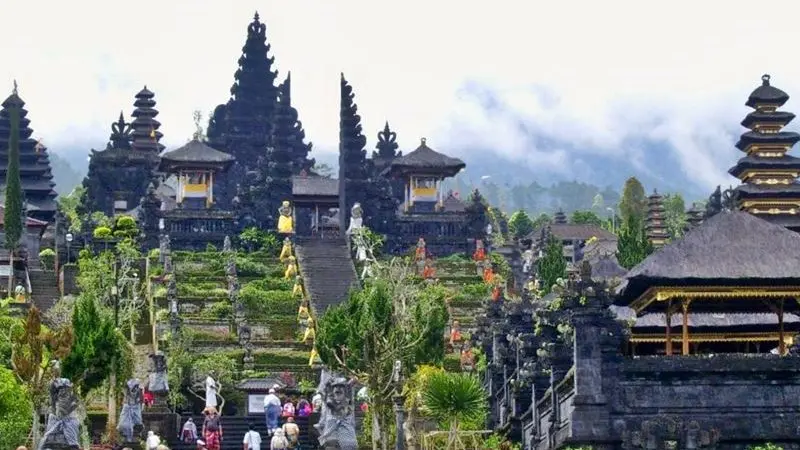
What sets Besakih apart is its sublime unity with the natural world. Tiered stone staircases ascend in alignment with the contours of the mountain, inviting both reverence and awe. Meru towers, with their multiple thatched roofs, rise like elegant fingers toward the heavens. Crafted from volcanic rock and adorned with traditional motifs, each structure honors a deity, a force, or a facet of the cosmos. There’s a poetic tension in the way the complex sprawls—structured yet organic, sacred yet accessible. Besakih doesn’t impose on nature; it converses with it.
4. Ceremonies and Rituals: The Living Pulse of Besakih
To visit Besakih during a major festival is to witness the island’s spirit in full bloom. The temple serves as the nucleus for ceremonies that mark the Balinese calendar—such as Bhatara Turun Kabeh, where deities from across Bali are symbolically invited to gather at the temple. Clad in radiant sarongs, worshippers carry offerings in ornate baskets, their movements choreographed by centuries of devotion. The air thickens with incense, gamelan rhythms, and mantras. These rituals are not performative; they are expressions of deep-seated cosmology, binding past, present, and future into a living tradition.
5. Navigating the Temple Complex
Besakih is a constellation of temples, with Pura Penataran Agung as its luminous core. This main temple is arranged in a series of ascending courtyards that symbolize the progression toward spiritual enlightenment. Visitors ascend through realms of increasing sanctity—from the outer jaba pisan (public courtyard) to the innermost jero (holy sanctum). Each sector is adorned with stone guardians, lotus ponds, and sanctified altars.
For a seamless journey to the temple and other iconic sites across the island, consider using a Bali private van hire service. It offers both convenience and comfort, especially for travelers who want the flexibility to explore at their own pace while avoiding the stress of navigation or local traffic. Whether you’re traveling solo or in a group, private transport allows you to absorb the island’s beauty without logistical worries.
Guides can enrich the experience, offering insight into symbolism that may otherwise go unnoticed. Respectful curiosity is always welcomed here.
6. Spiritual Significance and Cultural Impact
To Balinese Hindus, Besakih is not merely a place of worship—it is the cosmological center of the island. Every Balinese family maintains a spiritual connection to the temple, making pilgrimage here a sacred duty. Besakih embodies the triad of Tri Hita Karana—the Balinese philosophy of harmony among people, nature, and the divine. It shapes not only religious life but also art, music, dance, and architecture across the island. In a rapidly modernizing world, Besakih remains a steadfast anchor, reminding Bali of who it is.
7. When to Visit and What to Know
The best time to experience Besakih is during one of its vibrant festivals, though these can be crowded. Dry season (April to October) offers clearer skies and stunning views of Mount Agung. Modesty is paramount—visitors must wear a sarong and sash, both of which are often available for rent near the entrance. Local guides provide valuable cultural context, enriching the journey. While the spiritual energy here is palpable, it’s also subtle. Those who arrive with open hearts often leave with quiet revelations.
Besakih Temple is more than a monument; it is the heartbeat of a culture, a conduit between seen and unseen, and an enduring testament to the sacredness of place.
4o