The Soul of Bali: A Living Tapestry of Tradition
Bali isn’t just a tropical escape; it’s a living, breathing canvas of ancient tradition interwoven with everyday life. The island’s heartbeat doesn’t thrum only in its sunlit beaches or emerald rice terraces — it pulses strongest in its ceremonies. Each offering, chant, and procession is a poetic dialogue between humans, nature, and the unseen world. For travelers seeking depth beyond sunsets and smoothies, Bali’s cultural ceremonies are windows into the island’s ageless soul.
Nyepi — The Balinese Day of Silence
The Eve of Nyepi: Ogoh-Ogoh Parades and Mythical Symbolism
The prelude to silence is a spectacle of sound and shadow. On the night before Nyepi, towering effigies known as Ogoh-Ogoh take to the streets. Crafted from bamboo, papier-mâché, and unbridled imagination, these grotesque figures represent malevolent spirits — embodiments of human vices and chaos.
Communities spend weeks breathing life into these monstrous forms, only to parade them through the streets in a raucous exorcism of noise, firecrackers, and hypnotic gamelan beats. It is both theater and ritual, a communal defiance against negativity, before the world holds its breath.
A Day of Silence, Reflection, and Cosmic Reset
When dawn breaks on Nyepi, the entire island surrenders to an extraordinary stillness. Airports close, streets empty, even the surf seems to hush. No lights, no work, no travel — just a collective pause as the Balinese reset the cosmic balance.
This day of introspection is as much for the earth as it is for the self. Locals retreat indoors for prayer and meditation, while travelers are encouraged to embrace the rare luxury of digital silence. When night falls, the sky, unpolluted by human activity, reveals an astral masterpiece seldom witnessed elsewhere.
Galungan and Kuningan — The Triumph of Dharma
Penjor-Lined Streets: An Offering to the Ancestors
Twice a year, bamboo poles arch gracefully over every street, their ends festooned with young coconut leaves, fruits, and flowers. These penjor aren’t mere decorations; they’re symbolic mountains — bridges between the material world and the divine.
Galungan celebrates the victory of dharma (righteousness) over adharma (evil). During this time, it is believed ancestral spirits descend to visit their earthly families. Homes and temples bloom with offerings, while the island hums with prayers and age-old dances.
The Spiritual Homecoming and Farewell
Ten days later, Kuningan marks the conclusion of this spiritual homecoming. Offerings now sparkle with yellow rice — a symbol of prosperity and gratitude. The air feels lighter, as if the island itself exhales. It’s a reminder that life is transient, sacred, and beautifully cyclical.
Melasti Ceremony — Purifying the Universe
Sacred Pilgrimages to the Ocean
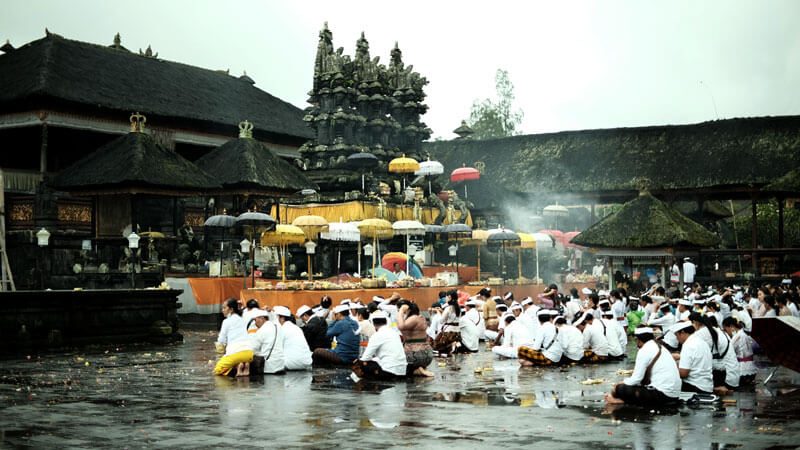
Days before Nyepi, Balinese communities, clad in white, make solemn pilgrimages to the sea. Priests chant sacred mantras as the faithful carry heirloom temple artifacts toward the crashing waves. The ocean is not merely water; it’s a celestial cleansing ground.
This ceremony, known as Melasti, embodies purification on a grand scale — not just for the individual, but for entire villages and the cosmos itself.
Symbolic Cleansing of the Mind, Body, and World
Participants bathe in the holy water, washing away emotional and spiritual impurities. The experience feels less like a ritual and more like surrendering to something infinitely larger. For observers, it’s a moving illustration of humility, harmony, and reverence for nature.
Exploring Bali’s ceremonial magic often requires more than just a map and curiosity. For a seamless and comfortable journey between villages and temples, many travelers opt for a reliable Bali private van hire. Having a local driver not only ensures you arrive on time for these enchanting rituals but also enriches the journey with personal insights and hidden gems you’d likely miss on your own. Whether you’re chasing sunrise blessings or joining a sunset temple celebration, traveling by private van turns every road into part of the experience.
Saraswati Day — Honoring the Goddess of Knowledge
The Sacredness of Books and Learning
Saraswati Day is a quiet yet profound celebration, devoted to Dewi Saraswati, the goddess of wisdom, learning, and the arts. Books, computers, musical instruments, and sacred texts are cleaned, blessed, and adorned with offerings.
In an age obsessed with instant information, this day stands as a gentle reminder: knowledge is sacred, and must be pursued with humility and care.
A Day of Grace and Intellectual Renewal
Children don their ceremonial attire and offer prayers at school temples, honoring the gift of education. It’s a day when intellectual pursuit meets spiritual reflection, creating a culture where learning isn’t merely practical, but profoundly sacred.
Odalan — Temple Anniversary Celebrations
A Feast for the Gods: Rituals, Dances, and Devotion
Every temple in Bali celebrates its own Odalan, a birthday marked by an explosion of color, music, and ceremonial grandeur. Villages transform into living temples; offerings pile high in kaleidoscopic abundance.
The air swirls with the scent of incense and frangipani, as traditional dances unfold — each movement a codified prayer in motion. These celebrations extend for days, reaffirming the community’s bond with the divine.
The Heartbeat of Balinese Village Life
Beyond their spiritual significance, Odalan festivals reinforce the social fabric. Families reunite, generations mingle, and the lines between the sacred and the secular dissolve in laughter, music, and shared meals. It’s the kind of festivity where even the moon seems to linger a little longer in the sky.
Tumpek Landep — The Blessing of Metal Objects
When Spirituality Meets Technology
In a world where technology is often seen as cold and impersonal, Tumpek Landep offers a refreshing contrast. This ceremony is devoted to the blessing of metal objects — from sacred kris daggers to modern motorcycles and computers.
The ritual acknowledges human ingenuity and the tools that shape daily life, blending ancient reverence with contemporary reality.
Honoring Human Ingenuity and Ancestral Wisdom
Through intricate offerings and priestly blessings, Tumpek Landep connects the past and the present. It reminds all who witness it that every creation, no matter how mundane, holds a spirit of intention and artistry worthy of gratitude.
Conclusion: A Journey Beyond Sightseeing
Bali’s ceremonies aren’t staged performances for the curious traveler. They are vibrant expressions of a worldview where everything is sacred — from the stone statues that stand sentinel at temple gates to the rice fields bathed in golden dusk. To witness these rituals is to feel, if only for a moment, part of the island’s eternal rhythm. And once you’ve experienced that, Bali ceases to be a destination. It becomes a second heartbeat.